
Many people have heard of the “SI joints,” but may not fully realise that these joints can be a significant source of low back pain, buttock discomfort, and sometimes even leg pain. SI joint dysfunction is often overlooked or mistaken for a disc or hip issue, making it worth understanding more closely.
If you’ve been experiencing lower back or buttock pain that doesn’t seem to fit the typical disc problem pattern, your SI joints might be involved. This guide explores what SI joints do, why they malfunction, and how you can address the problem.
Please note: This article is for informational and educational purposes only. If you’re experiencing persistent SI joint pain or dysfunction, consult with a healthcare professional for proper evaluation and guidance.
SI Joint Anatomy and Function
Understanding your SI joints begins with knowing where they are and what they do.
Location and Structure
Your sacroiliac joints (SI joints) connect the triangular sacrum bone at the base of your spine to the ilium bones of your pelvis. These are not freely moving joints like your hip or knee.
Key Characteristics:
- Strong ligaments hold them together
- Irregular joint surfaces make them very stable
- Limited range of motion compared to other joints
- Act as connectors between spine and legs
The Bridge Between Upper and Lower Body
In essence, your SI joints function like a stable “bridge” between your upper and lower body. They support everyday activities such as:
- Walking
- Bending
- Lifting
- Sitting down and standing up
- Climbing stairs
Unlike the hip or knee, which have large ranges of motion, your SI joints allow only small, controlled movements. This design prioritises stability—transferring loads between your spine and legs while maintaining structural integrity.[1]
Why Small Movements Matter
Though the SI joints have limited motion, that doesn’t mean they don’t move at all. The small movements they allow are crucial for:
Load Transfer: During walking or running, your SI joints transfer forces between your legs and spine, distributing stress evenly across your body.
Shock Absorption: Small movements help absorb impact from walking and jumping, protecting your spine and joints.
Pelvic Stability: The joints work together with muscles and ligaments to keep your pelvis stable during dynamic activities.
When these joints don’t move properly—either too much or too little—problems develop.
Causes and Risk Factors of SI Joint Dysfunction
SI joint dysfunction may occur when the joint moves too much (hypermobility) or too little (hypomobility). Multiple factors can contribute to this dysfunction.
Mechanical Causes
Pregnancy: Hormonal changes loosen ligaments, and the changing centre of gravity places stress on SI joints. This is one of the most common triggers for SI joint pain.
Pelvic Injury or Falls: Direct trauma to the pelvis can affect joint alignment and function.
Lifting and Twisting Movements: Heavy lifting, particularly with poor form or while twisting, can strain SI joints.
Structural and Postural Factors
Leg Length Differences: Even small differences in leg length can create asymmetrical stress on SI joints over time.
Arthritis: Degenerative changes in the joint can reduce mobility and create pain.
Poor Posture: Sustained poor posture can place stress on SI joints and surrounding structures.
Previous Spinal Surgery: Surgery can change load distribution, affecting SI joint stress.
Activity and Lifestyle Factors
Repetitive Activities: Jobs or activities involving repetitive bending, lifting, or twisted movements stress SI joints.
Sedentary Lifestyle: Weak stabilising muscles increase SI joint stress.
Asymmetrical Activities: Sports or activities that emphasise one leg or side can create imbalances.
Combined Risk Factors
Often, SI joint dysfunction results from a combination of factors rather than a single cause. For example:
- A person with a slight leg length difference who sits for long periods and plays one-sided sports
- A pregnant woman with poor posture and weak core muscles
- Someone recovering from hip surgery who changes their movement patterns
Common Symptoms of SI Joint Dysfunction
SI joint-related pain presents differently than disc-related pain, which helps distinguish the problem.
Pain Location and Character
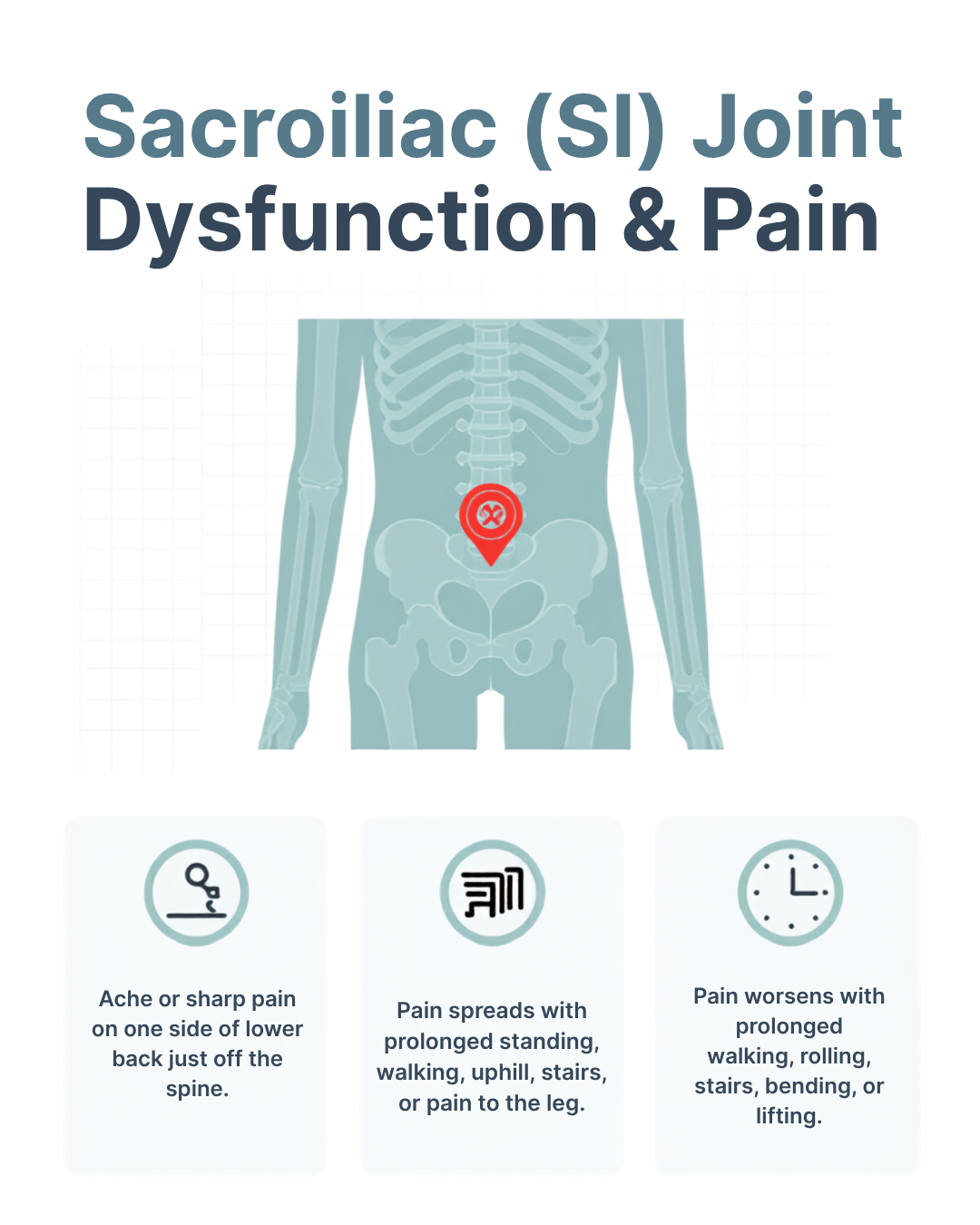
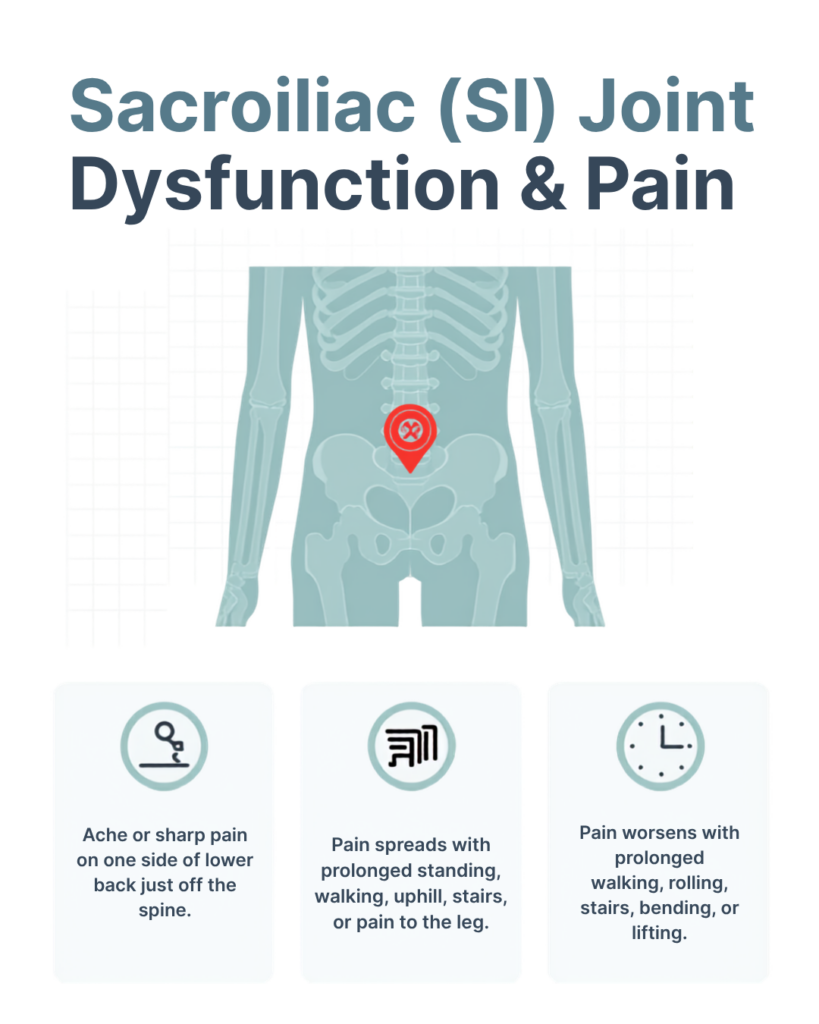
Lower Back Pain: Pain is typically felt on one side of the lower back, just off the spine. It may be a dull ache or sharp discomfort depending on the specific dysfunction.
Buttock Pain: Pain on one side of the buttock is common with SI joint issues.
Leg Pain: Some people experience pain that radiates down the thigh, though typically not below the knee (which is more common with disc problems).
Asymmetrical Pattern: SI joint pain is often one-sided rather than centred, which is a distinguishing characteristic.
When Pain Worsens
SI joint pain is often activity-dependent and typically worsens with:
- Prolonged standing
- Walking uphill
- Climbing stairs
- Rolling over in bed
- Activities involving bending and lifting
- Sitting for long periods (though sometimes better than standing)
- Running or high-impact activities
What May Help
Unlike some pain patterns that worsen with any movement, SI joint pain often improves with:
- Movement and activity (once acutely stabilised)
- Rest in certain positions
- Support or bracing
- Specific stabilising exercises
- Avoiding aggravating activities
This variable pain pattern is often a clue that SI joint dysfunction is the issue.
The SI Joint and Other Pain Sources
Because SI joint dysfunction is often overlooked, pain attributed to other structures may actually originate from the SI joint.
Disc Problems vs. SI Joint Problems
Disc-Related Pain:
- Often centred or bilateral (both sides)
- May include leg pain below the knee
- Typically worse with bending or flexion
- May cause nerve-related symptoms (numbness, tingling)
SI Joint Pain:
- Usually one-sided
- Buttock or lower back pain
- Worse with standing, stairs, or one-sided activities
- Activity-dependent pattern
Hip Problems vs. SI Joint Problems
Hip problems often create groin or front-of-hip pain, while SI joint problems typically create buttock or lower-back-sided pain. However, hip and SI joint problems can coexist, making assessment important.
Assessment and Management
Proper assessment is crucial because SI joint dysfunction requires different management than disc problems or hip issues.
Professional Assessment
Discussion of Symptoms: Assessment begins with understanding:
- Where your pain is felt
- How it started
- What activities make it better or worse
- How long you’ve had symptoms
Physical Examination: Assessment includes evaluating:
- Posture and alignment
- Spinal, hip, and pelvic movement
- How your spine, hips, and pelvis work together
- Pelvic stability and muscle function
- Specific clinical tests for SI joint dysfunction
Imaging: In some cases, specific clinical tests may guide whether X-rays or scans are needed to assess for structural issues.
Management Approaches
Management of SI joint dysfunction typically focuses on restoring proper joint mechanics and stability.
Exercises for Pelvic Stability: Specific exercises strengthen the muscles that support and stabilise your SI joints. These often include:
- Glute strengthening
- Core stabilisation
- Hip stabilisers
- Pelvic floor exercises
Movement and Posture Advice: Understanding how to move and position your body to reduce SI joint stress is essential. This includes:
- Proper lifting techniques
- Sitting and standing posture
- Bending mechanics
- Stair climbing techniques
Activity Modification: Temporarily reducing or modifying activities that aggravate your SI joints allows healing while maintaining overall activity.
Bracing or Support: Some people benefit from SI joint bracing or support, particularly during flare-ups or activity.
Manual Therapy: Specific adjustments or mobilisations may help restore proper joint mechanics and movement.
Core and Hip Strengthening: Building strength in muscles supporting the SI joint is often central to long-term management.
The Role of Movement
A common misconception is that SI joint pain means you should rest completely. Often the opposite is true—appropriate movement helps.
Why Movement Helps
Specific, gentle movement:
- Restores proper joint mechanics
- Strengthens supporting muscles
- Improves neuromuscular control
- Reduces pain over time
- Restores confidence in movement
Progressive Return to Activity
Effective management typically involves:
- Initial assessment and activity modification to reduce acute pain
- Specific stabilising and strengthening exercises
- Gradual return to normal activities
- Long-term maintenance through core strength and proper movement
The goal isn’t lifelong restriction—it’s restoring function and confidence to return to activities you enjoy.
Long-Term Management and Prevention
Once you understand your SI joint dysfunction, prevention becomes manageable.
Maintaining Stability
Regular Core and Hip Work: Consistent attention to core and hip strength maintains SI joint stability.
Awareness of Movement: Understanding how to move properly to protect your SI joints becomes automatic over time.
Activity Balance: Varying your activities rather than overloading one pattern reduces SI joint stress.
Addressing Contributing Factors: If leg length differences, arthritis, or other factors contribute, addressing them helps prevent recurrence.
When to Seek Professional Help
Professional assessment is important if:
- Pain persists despite activity modification
- You’re uncertain whether SI joints are the problem
- Pain is worsening or limiting your activities
- You need specific exercise guidance
- You want to prevent recurrence
A Chiropractic Perspective
At Adam’s Back, we frequently assess SI joint dysfunction, as it’s a common but often overlooked source of lower back and buttock pain.
Our Comprehensive Approach
Accurate Diagnosis: Distinguishing SI joint dysfunction from disc problems, hip issues, or other conditions is crucial. We use specific assessments and clinical tests to identify SI joint involvement.
Understanding Your Unique Situation: What caused your SI joint dysfunction? Is it pregnancy-related, activity-related, structural, or a combination? Understanding your specific situation guides treatment.
Specific Assessment: We evaluate:
- Pelvic alignment
- SI joint mobility
- Muscle strength and control
- Hip function
- Movement patterns
Targeted Treatment: Based on assessment findings, treatment may include:
- SI joint adjustments or mobilizations
- Specific stabilising exercises
- Movement and posture education
- Activity modification strategies
- Guidance on progression
Long-Term Support: We work with you to restore function and prevent recurrence through strength, awareness, and movement strategies.
The Overlooked Joint
SI joint dysfunction is often overlooked because:
- It’s not as well-known as disc problems
- Pain patterns can mimic other conditions
- Diagnosis requires specific knowledge and assessment
- Many healthcare providers don’t specifically assess SI joints
But if you have lower back pain on one side, buttock pain, or pain that worsens with certain activities, your SI joints should be assessed.
Visit Adam’s Back
Located at 881 Point Nepean Road in Rosebud, Adam’s Back provides comprehensive assessment and management for SI joint dysfunction.
If you’re experiencing lower back pain, buttock pain, or pain related to standing, walking, or stairs, we can help determine whether your SI joints are involved and create a personalized management plan.
Ready to address the real source of your pain? Contact us today.
📍 881 Point Nepean Road, Rosebud 📞 03 5986 5700 ✉️ info@adamsback.com.au 🌐 adamsback.com.au
Hours:
- Monday & Thursday: 9am–12pm, 2–6:30pm
- Tuesday, Wednesday & Friday: 10am–1pm, 3–6:30pm
- Saturday: 10am–1pm
References
[1] Vleeming A, Schuenke MD, Masi AT, et al. The sacroiliac joint: an overview of its anatomy, function and potential clinical implications. J Anat. 2012;221(6):537-567.
[2] Szadek KM, van der Wurff P, van Tulder MW, et al. Diagnostic validity of criteria for sacroiliac joint pain: a systematic review. J Pain. 2009;10(4):354-368.
[3] Arab AM, Abdollahi I, Joghataei MT, et al. The relationship between hip prosthesis and sacroiliac joint dysfunction in women: a case-control study. J Back Musculoskelet Rehabil. 2007;20(1):33-39.
[4] Dreyfuss P, Michaelsen M, Pauza K, et al. The value of medical history and physical examination in diagnosing sacroiliac joint pain. J Spine Disord. 1996;9(6):470-475.
[5] Richardson CA, Jull GA, Hodges PW, et al. Therapeutic Exercise for Spinal Segmental Stabilization in Low Back Pain: Scientific Basis and Clinical Approach. Philadelphia: Churchill Livingstone; 1999.
Disclaimer: This blog post is for informational and educational purposes only. It is not intended as medical advice and should not be used to diagnose or treat any health condition. The information presented does not replace professional chiropractic evaluation and treatment. Always consult with a qualified healthcare professional regarding SI joint pain, dysfunction, or other health concerns.

Comments are closed