
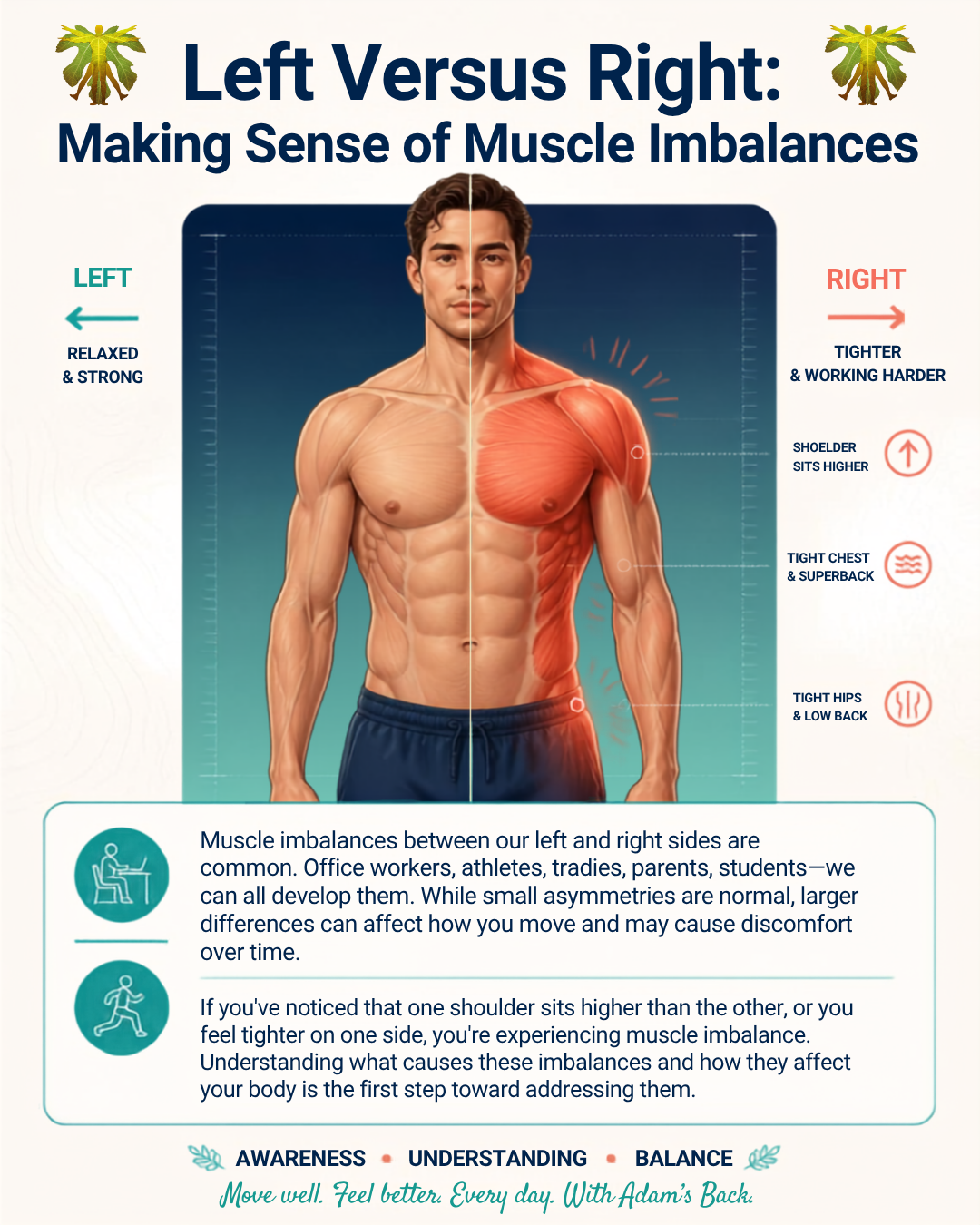
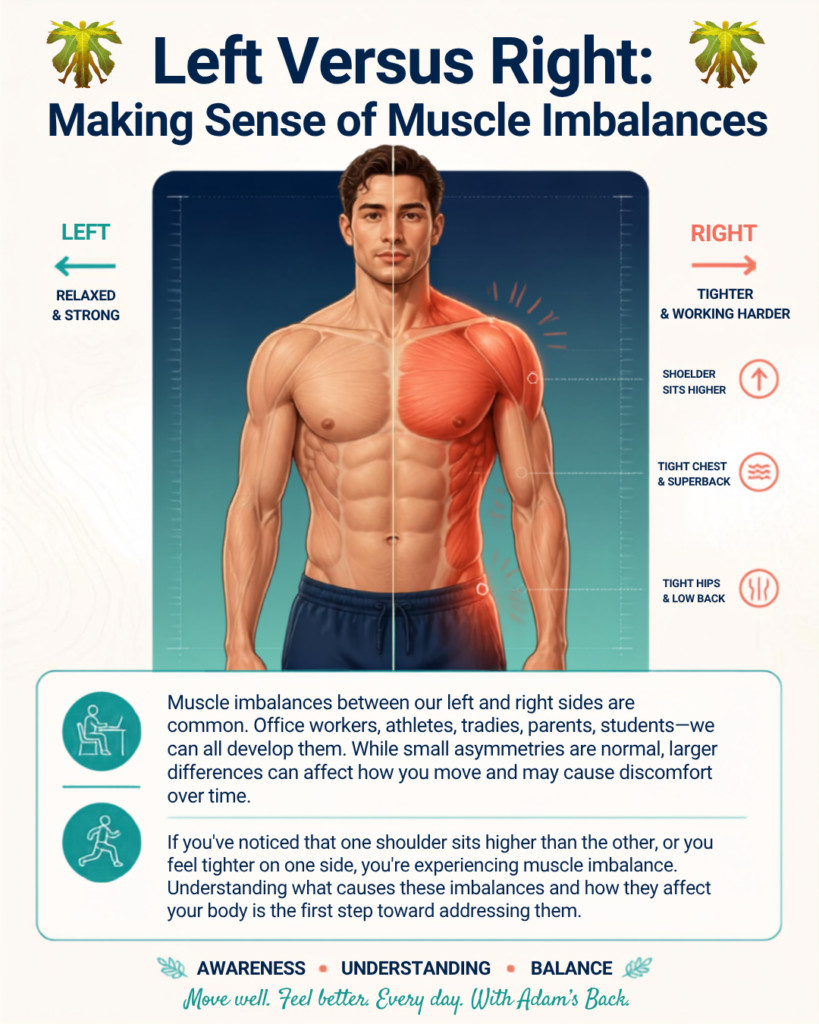
Muscle imbalances between our left and right sides are common. Office workers, athletes, tradies, parents, students—we can all develop them. While small asymmetries are normal, larger differences can affect how you move and may cause discomfort over time. Explore left versus right muscle imbalances and learn how they can impact your movement and comfort over time.
If you’ve noticed that one shoulder sits higher than the other, or you feel tighter on one side, you’re experiencing muscle imbalance. Understanding what causes these imbalances and how they affect your body is the first step toward addressing them.
Please note: This article is for informational and educational purposes only. If you’re experiencing persistent muscle imbalance, asymmetrical pain, or functional limitations, consult with a chiropractor for proper evaluation and guidance.
What Are Muscle Imbalances?
Muscle imbalances occur when muscles on one side of your body become stronger, tighter, or less flexible than the corresponding muscles on the other side.
Why They Develop
Your body is not perfectly symmetrical—and that’s normal. However, certain factors can create noticeable differences:
Dominance Patterns: Most people are naturally right- or left-handed. This dominance can extend to your entire body, creating a preferred side. Your dominant side tends to be stronger and may be used more frequently.
Repetitive Use: Jobs and activities that emphasise one side create imbalances. For example:
- A carpenter who swings a hammer repeatedly with their dominant hand
- A tennis player who develops stronger muscles on their playing arm side
- An office worker who always carries their bag on the same shoulder
- A parent who habitually carries their child on one hip
Injury and Compensation: When you injure one side, you instinctively protect it by using the other side more. Even after the injury heals, these compensation patterns can persist, leading to lasting imbalances.
Postural Habits: Daily habits create imbalances:
- Always crossing your legs the same way
- Leaning more weight on one leg while standing
- Sleeping on the same side
- Holding your phone on the same shoulder
- Always carrying your bag on the same side
Inactivity on One Side: Some people simply move one side less than the other due to habit or preference, leading to deconditioning on that side.
Natural Preference: Some muscle imbalances result from genetics or neuromuscular preferences—you simply use one side more naturally.
What Effects Do Muscle Imbalances Have?
When one side becomes stronger or tighter than the other, it can create several consequences for your body’s function.
Changes in Movement Patterns
One of the most significant effects of muscle imbalance is altered movement. When muscles on one side are stronger or tighter:
Compensatory Movement: Your body works hard to compensate for the imbalance. Rather than moving symmetrically, you develop asymmetrical movement patterns. One side takes more responsibility for movement while the other side becomes more passive.
Postural Changes: Over time, muscle imbalances cause postural changes:
- One shoulder higher than the other
- One hip tilted higher
- Your spine may curve asymmetrically
- Your head may tilt to one side
- Your pelvis may rotate
Stress on Multiple Areas: Because your body is now moving asymmetrically, it distributes stress unevenly across joints, muscles, tendons, and ligaments. Areas that bear extra load experience increased stress and fatigue.
Stiffness and Discomfort
As imbalances develop, you may notice:
Tightness on the Stronger/Tighter Side: The side with stronger or tighter muscles feels restricted or tense.
Weakness or Fatigue on the Other Side: The weaker side may feel unstable or tire more easily.
Discomfort in Multiple Areas: Rather than pain in one specific location, muscle imbalance can cause stiffness or discomfort across multiple areas:
- Knees (bearing extra load)
- Hips (pulled out of alignment)
- Shoulders (rotated or elevated)
- Neck (compensating for shoulder/postural changes)
- Lower back (asymmetrical loading)
The Domino Effect: Cascading Strain
Here’s where muscle imbalance becomes problematic: When one side carries extra responsibility, it places strain on muscles, joints, tendons, and ligaments throughout that entire chain.
Example: If your left side is weaker and your right side stronger, your body automatically loads more stress onto your right side. Over time, this extra load can cause:
- Overuse injuries on the right
- Strain on right knee, hip, and lower back
- Muscle fatigue on the right side
- Possible inflammation or pain on the right side
Meanwhile, the weaker left side may develop secondary issues from underuse and compensation.
The Misalignment Analogy: Think of it like driving with misaligned wheels. Even if the misalignment is slight, over time you get uneven tire wear. With your body, the “wear” appears as muscle tension, joint stress, and eventual pain or injury.
What Causes Muscle Imbalances?
Understanding the causes helps you recognise why imbalances develop and how to prevent them.
Occupational and Activity-Based Causes
Repetitive Movements at Work:
- Construction workers who hammer or saw primarily with one hand
- Assembly line workers performing one-sided repetitive tasks
- Office workers who hold the phone against one ear
- Tennis players, baseball players, and other sport-specific athletes
- Dancers who emphasise movement on one side
One-Sided Sports and Hobbies:
- Tennis (dominant arm is significantly stronger)
- Baseball and softball (throwing arm develops imbalances)
- Golf (asymmetrical swing)
- Fencing (one-sided sport)
- Swimming strokes (if primarily one stroke)
Occupational Posture:
- Jobs requiring standing on one leg more than the other
- Work that involves reaching predominantly to one side
- Truck drivers sitting with one arm extended for hours
- Dentists and hairdressers working predominantly on one side of their clients
Habitual Movement Patterns
Carrying Habits:
- Always carrying your bag on the same shoulder
- Habitually holding your child on the same hip
- Carrying tools or equipment on one side
- Always carrying weight asymmetrically
Sitting and Postural Habits:
- Always crossing your legs the same way
- Leaning more weight on one hip while sitting
- Sitting with your body rotated toward one side
- Always tucking one leg underneath while sitting
Standing Patterns:
- Always standing with weight on the same leg
- Hip thrust to one side while standing
- Placing the other foot on a stool (at bars or counters)
- Asymmetrical stance during daily activities
Sleeping Position:
- Always sleeping on the same side
- Favouring one side during sleep
- Using a pillow that twists your neck to one side
Injury-Related Causes
Post-Injury Compensation: When you injure one side, you naturally protect it by:
- Using the other side more
- Moving asymmetrically to avoid pain
- Reducing movement on the injured side
Even after the injury heals, these compensation patterns often persist. Your nervous system has learned to move asymmetrically, and changing that pattern requires conscious effort.
Surgical Recovery: Similar to injury, post-surgical recovery often involves protecting one side, creating long-lasting compensation patterns.
Chronic Pain: People with chronic pain on one side often develop significant imbalances as they unconsciously protect the painful side.
Structural and Biological Factors
Leg Length Discrepancy: Even small differences in leg length can create asymmetrical stress over time, leading to muscle imbalances throughout the body.
Natural Dominance: Genetic and neurological factors create natural dominance. Right-handed people typically have stronger, more developed muscles on their right side.
Arthritis and Degenerative Changes: Arthritis in joints can make movement painful on one side, leading to reduced use and muscle weakness on that side, while the opposite side compensates and becomes stronger.
Should You Be Concerned About Muscle Imbalances?
The answer depends on the degree of imbalance and whether it’s affecting your function or causing discomfort.
When Small Imbalances Are Normal
Humans Are Not Perfectly Symmetrical: Expecting perfect symmetry is unrealistic. Most people naturally have one side slightly stronger or more dominant than the other.
Mild Differences Are Expected: Small muscle imbalances are a natural consequence of being a handed species (predominantly right-handed or left-handed). These mild differences generally don’t cause problems.
Dominance Is Normal: Having a dominant side that’s stronger or more coordinated is perfectly normal and doesn’t require correction.
When Imbalances Warrant Assessment
Noticeable Discomfort: If you’re experiencing ongoing discomfort, frequent tightness in one area, or one-sided pain, assessment is worthwhile.
Postural Changes: Visible postural changes—one shoulder noticeably higher than the other, or obvious curvature—may warrant assessment to ensure they’re not creating problems.
Recurring Issues: If you notice that pain or problems tend to affect the same side repeatedly, muscle imbalance may be contributing.
Headaches on One Side: Persistent one-sided headaches can sometimes result from muscle imbalances and tension patterns.
Functional Limitations: If muscle imbalance is affecting your ability to do activities or causing you to modify your movements to avoid discomfort, assessment is valuable.
More Significant Changes
Visible Muscle Size Differences: If one limb is noticeably more muscular or developed than the other, or appears smaller or atrophied, assessment is recommended.
Clear Strength Differences: A significant difference in grip strength, or noticeably weaker movement on one side, warrants evaluation.
Asymmetrical Weakness: If one side regularly feels weaker than the other during activities, professional evaluation can identify contributing factors.
New or Worsening Changes: If you’ve noticed recent changes in imbalance, or if imbalances are worsening over time, assessment is important.
Affecting Daily Activities: If muscle imbalance is limiting your activities, changing how you move, or causing pain that restricts what you can do, professional care is warranted.
How Muscle Imbalances Develop: Common Scenarios
Understanding how imbalances develop in real life can help you recognise patterns in your own situation.
The Office Worker Scenario
The Situation: Sarah works at a desk, primarily using her right hand for mouse work. She carries her bag on her left shoulder during her commute. She always crosses her right leg over her left while sitting.
Over Time: Her right arm and shoulder become stronger from repetitive mouse use. Her left side is under-utilised. From carrying her bag on her left shoulder, her left shoulder becomes tight while her right develops postural imbalance.
The Result: After a year, Sarah’s right shoulder sits higher than her left. She has persistent tension in her left shoulder and occasionally experiences right-sided neck pain. Her right side feels stronger, but she also feels “tight” there.
The Cascade: Because of her postural changes, her spine has developed a slight curve favouring the right. This is now affecting her lower back, which is also experiencing one-sided tension.
The Athlete Scenario
The Situation: Marcus is a tennis player who trains 5 days per week. His dominant arm is his right side.
Over Time: His entire right side—arm, shoulder, core—develops significantly more strength and muscle mass than his left. This asymmetry is dramatic enough to be visible.
The Result: While his dominance provides performance advantage for tennis, it’s creating movement imbalances. His right shoulder is pulled higher, and his spine curves slightly toward the right.
The Potential Problem: If Marcus doesn’t actively work to balance his body, his one-sided training may eventually create injury risk. The extra load on his right side could lead to overuse injuries, and his underdeveloped left side may struggle to support movement.
The Parent Scenario
The Situation: Jennifer habitually carries her toddler on her left hip. She’s been doing this for 3 years.
Over Time: Her left hip, glute, and lower back strengthen and adapt to this regular load. The repeated weight-bearing on her left leg creates imbalances in her core and lower body.
The Result: Her pelvis is tilted, with her left hip higher. Her lower back feels tight on the left side, especially after carrying her child.
The Impact: This postural change affects how she walks, bends, and lifts. If she continues without addressing the imbalance, she may develop more significant pain or movement limitations.
Correcting Muscle Imbalances
The good news: Muscle imbalances are addressable through targeted strategies.
Strengthening Weaker Areas
Identify Weak Muscles: The first step is determining which muscles are weaker or less developed on one side.
Targeted Strengthening: Once identified, specific exercises can strengthen weaker areas:
- Progressive resistance exercises for weak muscles
- Unilateral exercises that work one side at a time
- Exercises that emphasise the weaker side
- Functional movements that incorporate weak areas
Progressive Overload: Gradually increasing challenge and resistance helps rebuild strength on the weaker side.
Relaxing and Stretching Tighter Areas
Identify Tight Muscles: Determine which muscles are tight or overactive on the stronger side.
Gentle Stretching: Regular, gentle stretching of tight areas helps restore length:
- Static stretching (hold positions)
- Dynamic stretching (movement-based)
- Foam rolling or self-massage
- Professional soft tissue work
Relaxation Techniques: Beyond stretching, relaxation helps:
- Deep breathing
- Progressive muscle relaxation
- Gentle movements
- Yoga or tai chi
Varying Daily Movements
Break Habitual Patterns: Once you recognise your habits, consciously varying them helps:
- Alternate which shoulder you carry your bag on
- Switch which leg you cross while sitting
- Alternate which hip you hold your child on
- Vary which side you sleep on
Conscious Movement: Being mindful of movement during daily life helps:
- Varying your weight distribution while standing
- Alternating sides during repetitive tasks when possible
- Consciously using both sides during daily activities
- Reducing one-sided repetitive movements
Reducing Repetitive One-Sided Activities
For Athletes: While sport-specific training creates imbalances, cross-training and opposite-side development helps:
- Tennis players can practice their weaker side
- Baseball players can work on arm strength balance
- Sport-specific athletes can do general fitness that emphasises balance
For Workers: If your job is one-sided:
- Take movement breaks that work both sides
- Alternate tasks when possible
- Do stretching and strengthening exercises outside of work
- Modify your work setup to reduce one-sided positioning
For Regular People: Recognising one-sided habits in daily life and varying them helps prevent imbalances from worsening.
Professional Assessment and Treatment
While many muscle imbalances can be self-managed, professional assessment is valuable for more significant imbalances.
Comprehensive Evaluation
Movement Assessment: A healthcare provider can evaluate:
- Posture and alignment
- Movement quality and symmetry
- Muscle strength on both sides
- Muscle length and flexibility
- Joint mobility
- Functional movement patterns
Identifying Contributing Factors:
- Occupational or activity-related causes
- Habitual movement patterns
- Previous injuries
- Structural factors
- Lifestyle factors
Specific Testing: May include:
- Strength testing of specific muscles
- Flexibility assessment
- Functional movement tests
- Posture analysis
- Gait evaluation
Professional Treatment Options
Manual Therapy: Chiropractors can assist to:
- Release tight muscles and fascia
- Mobilise restricted joints
- Improve muscle function
- Reduce muscle tension
Exercise Prescription: Tailored exercise programs address:
- Strengthening weak muscles
- Stretching and relaxing tight muscles
- Improving movement quality
- Building functional balance
Movement Retraining: Learning to move in balanced, symmetrical ways helps:
- Break compensation patterns
- Improve posture
- Reduce asymmetrical stress
- Prevent recurrence
Ergonomic Guidance: For occupation-related imbalances:
- Optimising work setup
- Positioning strategies
- Movement breaks
- Task modification
Long-Term Prevention
Once you’ve addressed muscle imbalances, preventing recurrence is important.
Maintaining Balance
Ongoing Strengthening: Continuing to work on weaker muscles prevents them from weakening again.
Regular Stretching: Maintaining flexibility on tight side prevents tightness from returning.
Varied Movement: Continuing to vary your movements and avoid one-sided habits keeps imbalances from redeveloping.
Postural Awareness: Being mindful of posture and positioning during daily life maintains balance.
Addressing Contributing Factors
Modifying Habits: If one-sided habits caused the imbalance, continuing to modify them prevents recurrence:
- Alternating bag shoulders
- Varying carrying positions
- Changing sitting positions
- Rotating sleep sides
Breaking Repetitive Patterns: If work or sports cause imbalance, continuing to address them helps:
- Cross-training
- Opposite-side development
- Taking regular breaks
- Stretching and strengthening outside of activity
Movement Variety: Continuing to move in varied ways prevents new imbalances from developing.
A Chiropractic Perspective
At Adam’s Back, muscle imbalances are a common issue we assess and address.
Our Approach
Identifying Imbalances: We specifically assess:
- Postural asymmetries
- Muscle strength and flexibility differences
- Movement pattern asymmetries
- Functional limitations
Understanding Your Situation: We investigate:
- What caused the imbalance (occupational, activity-based, habit-based, injury-related)
- How long you’ve had it
- Whether it’s causing problems
- What activities are affected
Addressing Root Causes: Rather than just treating symptoms, we address:
- Why the imbalance developed
- What habits or patterns perpetuate it
- How to correct movement patterns
- How to prevent recurrence
Personalised Treatment: Based on your assessment, treatment may include:
- Manual therapy to address tight muscles
- Specific exercises to strengthen weak areas
- Movement retraining and postural correction
- Ergonomic and habit modification guidance
- Ongoing maintenance strategies
The Goal
Our goal is not just to reduce current discomfort, but to help you understand your imbalances and maintain better balance going forward. This prevents problems from returning and supports long-term health and function.
Visit Adam’s Back
Located at 881 Point Nepean Road in Rosebud, Adam’s Back provides assessment and management for muscle imbalances and asymmetrical movement patterns.
If you’re noticing postural changes, one-sided tightness, or movement limitations, we can help identify contributing factors and create a plan to restore balance and function.
📍 881 Point Nepean Road, Rosebud 📞 03 5986 5700 ✉️ info@adamsback.com.au 🌐 adamsback.com.au
Hours:
- Monday & Thursday: 9am–12pm, 2–6:30pm
- Tuesday, Wednesday & Friday: 10am–1pm, 3–6:30pm
- Saturday: 10am–1pm
References
[1] Neumann DA. Kinesiology of the Musculoskeletal System: Foundations for Physical Rehabilitation. 3rd ed. St. Louis: Mosby; 2010.
[2] Kendall FP, McCreary EK, Provance PG, et al. Muscles: Testing and Function with Posture and Pain. 5th ed. Baltimore: Wolters Kluwer Health; 2005.
[3] Comerford MJ, Mottram SL. Functional stability re-training of the lumbo-pelvi-hip complex. In: Jull G, Richardson C, Hodges PW, eds. Therapeutic Exercise for Spinal Segmental Stabilization in Low Back Pain. Edinburgh: Churchill Livingstone; 1999.
[4] Pincivero DM, Coelho AJ, Campy RM. Gender differences in perceived exertion during maximal concentric and eccentric quadriceps contractions. J Strength Cond Res. 2004;18(3):568-573.
[5] Beekley MD, Sato AK, Daller JA, et al. Relationships among leg length discrepancy, postural asymmetry, and low back pain. J Chiropr Med. 2005;4(2):59-63.
Disclaimer: This blog post is for informational and educational purposes only. It is not intended as medical advice and should not be used to diagnose or treat any health condition. The information presented does not replace professional chiropractic evaluation and treatment. Always consult with a qualified healthcare professional regarding muscle imbalances, postural concerns, or other health matters.

Comments are closed