
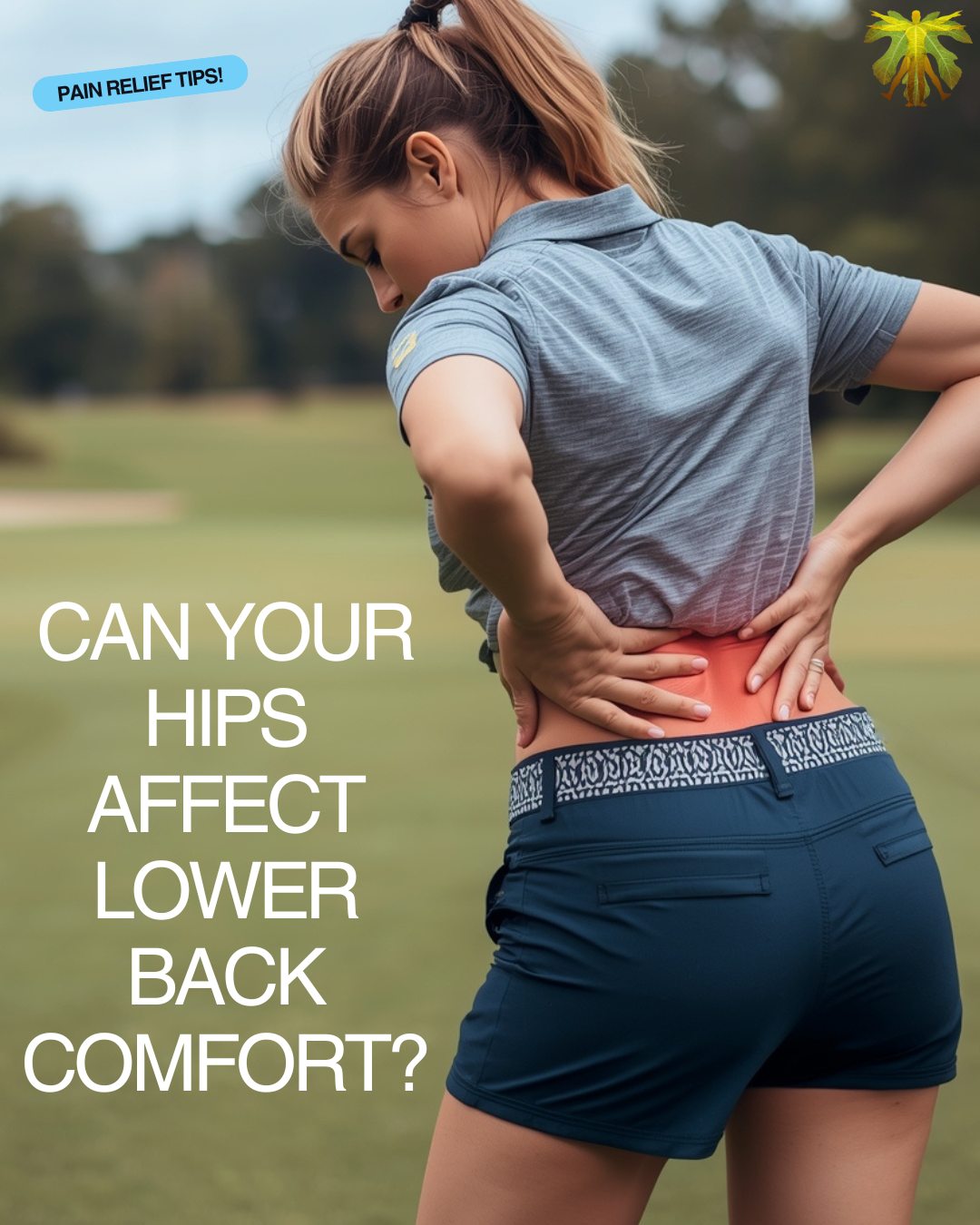
Do you experience lower back discomfort but can’t quite figure out where it’s coming from? The answer might not be in your back at all—it could be in your hips. We often think of the body in parts—hips, pelvis, spine—but in reality, it works as one connected system. Your hips connect your lower body and spine, and play a crucial role in helping you bend, walk, twist, and change direction smoothly.
Limited hip movement forces your lower back to work harder. Over time, this may increase strain on the joints and discs in your spine, leading to discomfort, stiffness, and even chronic pain. Understanding this connection is the first step toward addressing the root cause of your back issues rather than just managing symptoms.
Please note: This article is for informational purposes only and does not constitute personal health advice. Always consult with your chiropractor for personalised assessment and treatment of hip or back pain.
The Hip-Back Connection: Understanding the Kinetic Chain
Your body functions as an integrated system where movement in one area affects movement everywhere else. This concept, known as the kinetic chain, is important when understanding the relationship between your hips and lower back.[1]
The hips and pelvis form the foundation for spinal movement. When your hips move properly through their full range of motion, they can efficiently handle the demands of bending, rotating, and weight-bearing activities. If your hips lack mobility, your body doesn’t just stop moving; it finds other ways to perform the task, frequently causing your lower back to compensate.
How Sitting Affects Your Hips and Glutes
In our modern world, prolonged sitting has become the norm for many people. Whether it’s desk work, commuting, or relaxing at home, the average person spends a significant portion of their day seated. This seemingly harmless position has profound effects on your hip and glute muscles.
The Hip Flexor Problem
Prolonged sitting keeps the hip flexors—the muscles that lift your knees towards your chest—in a shortened position. Hour after hour, day after day, these muscles adapt to this shortened state. Over time, this may cause tightness and limit flexibility.[2]
When you stand up after extended sitting, these tight hip flexors don’t immediately return to their optimal length. This can change how the pelvis and spine move together. Instead of your hips providing the mobility needed for movement, your lower back compensates by moving more than it should.
Under active Glute Muscles
At the same time your hip flexors are becoming tight, your glute muscles are less active when you sit for long stretches. The gluteal muscles—particularly the gluteus maximus and gluteus medius—are powerful stabilisers and movers of your hips and pelvis.[3]
When these muscles become underused, they may provide less support and power when you stand, walk, or climb stairs. This combination of tight hip flexors and underused glutes can alter your posture and the way you walk. Gradually, these changes may set the stage for overload and discomfort in the hips and lower back.
If your glutes aren’t strong enough to keep your pelvis steady and help you move, your lower back will have to work harder.
Why Your Back May Have to Work Harder
When your hips don’t rotate or extend properly, your body finds workarounds to accomplish everyday tasks. These compensatory patterns allow you to continue moving, but they come at a cost.
Compensatory Movement Patterns
Restricted hips make everyday tasks like walking, lifting, or getting in and out of the car harder. Your lower back picks up the slack, working overtime to compensate for what your hips should be doing.[4]
For example:
- Bending forward: If your hips can’t hinge properly, your spine bends more to reach the ground
- Picking up objects: Limited hip mobility forces excessive rounding of the lower back
- Walking: Restricted hip extension causes your spine to rotate more with each step
- Getting in and out of a car: Tight hips require more spinal twisting and bending
The Cumulative Effect
Repeatedly bending or twisting through the spine instead of the hips can irritate joints, muscles, and discs. It’s like forcing a door to bend in the middle instead of opening at the hinges. The door might move, but it’s using the wrong mechanism, and eventually, something will give.
Over time, this extra load may contribute to:
- Stiffness in the lower back
- Muscle spasm and tension
- Joint irritation
- Disc strain
- Chronic back pain
- Reduced mobility and function
The insidious nature of this problem is that it progresses gradually. You might notice nothing at first, but over weeks, months, and years, the cumulative stress builds until you develop symptoms.
Testing Your Hip Mobility: A Simple Self-Assessment
Want to know if your hips might be contributing to your back discomfort? Try this simple test:
The Squat Test:
- Stand with your feet about shoulder-width apart
- Squat down as if picking something up from the floor
- Try to keep your back as upright as possible while squatting
- Notice what happens as you try again while keeping your hips as still as possible
What to observe:
- Can you squat down comfortably with good hip mobility?
- Do you feel your back working harder when you limit hip movement?
- Is the movement more limited when you try to keep your hips still?
- Do you feel tightness or restriction in your hips?
If you notice that your back has to work significantly harder when you minimise hip movement, or if you feel restricted in your hips, this suggests your hips may not be moving through their full range of motion. This limitation is likely forcing your lower back to compensate.
Signs That Your Hips May Be Restricted
How do you know if your hips are contributing to your back problems? Here are some common signs that indicate compromised hip mobility:
Difficulty with Daily Activities
Trouble comfortably crossing your legs: If you find it difficult or uncomfortable to cross one leg over the other while sitting, this may indicate tight hip rotators or limited hip flexibility.
When hip mobility is limited, tasks involving hip flexion combined with rotation, such as putting on socks or tying shoelaces, become difficult to perform.
One hip consistently feels “tighter” than the other: Asymmetry in hip mobility is common and can lead to compensatory patterns that stress one side of your lower back more than the other.
Pain and Discomfort Patterns
Pain or aching around your lower back or groin: Hip problems don’t always present as hip pain. Sometimes the discomfort manifests in the lower back, groin, or even down the leg.
Hip stiffness first thing in the morning, or after sitting for a while: If your hips feel stiff when you first wake up or after prolonged sitting, this indicates that the tissues have tightened during periods of inactivity.
Movement Limitations
Reduced stride length when walking: If your hips don’t extend fully, your steps become shorter, and your gait pattern changes.
Difficulty with activities requiring hip rotation: Sports like golf or tennis, or even simple activities like getting dressed, become more challenging.
Compensatory movements: You might notice yourself twisting your whole body to accomplish tasks that should primarily involve hip movement.
These signs are not a diagnosis on their own, but they’re a good prompt to pay attention to your hip mobility and consider seeking professional assessment.
Tips to Support Your Hips and Spine
You can improve hip mobility, and providing support to your hips significantly eases the burden on your lower back. Here are evidence-based strategies to help:
1. Take Regular Movement Breaks
The 30-minute rule: Take breaks from sitting about every 30 minutes. Even brief movement breaks can help prevent your hip flexors from staying in a shortened position for too long.[5]
What to do during your breaks:
- Stand up and walk around for 1-2 minutes
- Perform gentle hip circles
- Do a few standing hip flexor stretches
- March in place, lifting your knees
Consider a sit-stand desk: If possible, use a sit-stand desk that allows you to alternate between sitting and standing throughout the day. (See our article on standing desks for posture tips and proper setup guidance.)
2. Incorporate Hip Mobility Exercises
Hip flexor stretches: Gentle stretching of the hip flexors can help restore length to muscles that have adapted to prolonged sitting.
Example – Kneeling hip flexor stretch:
- Kneel on one knee with the other foot flat on the floor in front
- Keep your torso upright
- Gently push your hips forward until you feel a stretch in the front of your hip
- Hold for 20-30 seconds
- Repeat 2-3 times on each side
Glute activation exercises: Strengthening your glutes helps restore their role in hip and pelvic stability.
Examples include:
- Bridges: Lie on your back with knees bent, lift your hips toward the ceiling
- Clamshells: Lie on your side with knees bent, lift your top knee while keeping feet together
- Single-leg glute bridges: Progress to single-leg variations as strength improves
3. Strengthen Your Hips and Core
Squats and sit-to-stands: These functional exercises help improve strength and mobility in a movement pattern you use every day.[6]
- Start with chair squats (sitting down and standing up from a chair)
- Progress to bodyweight squats
- Focus on slow, controlled movement and good form
- Keep your chest up and push through your heels
Comfortable squats: Practice squatting with proper form to improve hip mobility and strength simultaneously.
Core stability work: A strong core supports proper movement patterns and reduces the load on your spine.
- Planks and modified planks
- Bird dogs (opposite arm and leg extensions)
- Dead bugs (coordinated arm and leg movements while lying on your back)
4. Focus on Movement Quality
Slow, controlled movement and good form: Speed isn’t the goal—quality is. Moving slowly and mindfully helps you notice compensatory patterns and teaches your body better movement strategies.[7]
Mind-muscle connection: Pay attention to which muscles you’re using during exercises. Are you feeling the movement in your hips and glutes, or is your back doing most of the work?
Progress gradually: Don’t rush into advanced exercises. Master the basics first, then progress as your mobility and strength improve.
5. Address Postural Habits
Sitting posture: When you must sit for extended periods:
- Sit back in your chair with your back supported
- Keep your feet flat on the floor
- Avoid crossing your legs for long periods
- Use a small cushion or lumbar support if needed
Standing posture: When standing:
- Distribute weight evenly on both feet
- Avoid standing with all your weight on one leg
- Keep your knees slightly soft, not locked
Sleep position: Your sleeping position can affect hip mobility:
- Side sleepers: Place a pillow between your knees to keep hips aligned
- Back sleepers: A small pillow under your knees can reduce hip flexor tension
The Role of Chiropractic Care
At Adam’s Back, we understand the intricate relationship between hip mobility and lower back health. Our approach goes beyond just treating where it hurts—we assess how the hips, pelvis, and spine move together to identify the root cause of your discomfort.
Comprehensive Assessment
Chiropractors assess how the hips, pelvis, and spine move together, not just where pain shows up. Our evaluation includes:
Movement analysis: We observe how you move through basic patterns like bending, squatting, and walking to identify compensatory strategies.
Joint mobility testing: We assess the range of motion in your hips, pelvis, and spine to identify restrictions.
Muscle balance evaluation: We check for tightness in hip flexors and weakness in glutes and other supporting muscles.
Posture assessment: We evaluate how your standing and sitting posture may contribute to hip and back problems.
This comprehensive approach helps us understand not just what hurts, but why it hurts, allowing us to address the underlying cause.
Targeted Treatment
We check joint mobility, muscle balance, and posture, which helps guide care aimed at improving movement and overall comfort. Treatment may include:
Chiropractic adjustments: Restoring proper joint motion in the hips, pelvis, and spine reduces compensatory stress and allows for more efficient movement patterns.[8]
Soft tissue therapy: Addressing tight hip flexors, underactive glutes, and compensating back muscles through hands-on techniques.
Rehabilitation exercises: Customised exercise programs designed to address your specific imbalances and movement restrictions.
Ergonomic advice: Guidance on optimising your work setup, sleeping position, and daily habits to support hip and spine health.
Movement re-education: Teaching you how to move efficiently using proper hip mechanics rather than relying on compensatory back movement.
Prevention: The Long-Term Approach
Once you’ve improved your hip mobility and reduced back discomfort, the goal is to maintain these gains and prevent problems from returning.
Building Sustainable Habits
Regular movement throughout the day: Make movement breaks a non-negotiable part of your daily routine, just like brushing your teeth.
Consistent exercise routine: Incorporate hip mobility and strengthening exercises into your weekly schedule. Even 10-15 minutes, 3-4 times per week can make a significant difference.
Postural awareness: Develop an awareness of your posture during daily activities. Notice when you’re sitting in a slouched position or standing with your weight on one leg and make adjustments.
Progressive challenge: As your mobility and strength improve, gradually increase the challenge of your exercises to continue building resilience.
Monitoring Your Progress
Track functional improvements: Notice if daily activities become easier:
- Can you bend down to tie your shoes more comfortably?
- Is getting in and out of the car less awkward?
- Do you have an easier time putting on socks?
- Can you walk farther or faster without back discomfort?
Reassess periodically: Every few weeks, repeat the squat test or other self-assessments to gauge your progress.
Maintain professional support: Regular check-ins with your chiropractor can catch minor issues before they become big problems and help you continue progressing toward optimal movement.
When to Seek Professional Help
While the strategies outlined in this article can be helpful for general hip and back health, certain situations warrant professional assessment:
Seek help if you experience:
- Persistent hip or back pain despite self-care efforts
- Pain that worsens over time
- Difficulty with basic daily activities
- Numbness, tingling, or weakness in your legs
- Pain that radiates down your leg
- Significant asymmetry between your left and right hips
- Pain that interferes with sleep
- A sudden change in your symptoms
Early intervention is often more effective and can prevent acute problems from becoming chronic issues. Don’t wait until the problem severely limits your function—address it while it’s still manageable.
The Bottom Line
Strong muscles and mobile joints work together to support your entire body. Your hips are the foundation for spine health, and when they move well, your back doesn’t have to work overtime. These articles explore their connection and show simple ways to help keep your whole body balanced and supported.
Understanding the hip-back connection empowers you to:
- Identify potential sources of your back discomfort
- Take proactive steps to improve hip mobility
- Reduce the compensatory stress on your spine
- Move more efficiently and comfortably
- Prevent future problems through better movement patterns
Whether you’re dealing with current back discomfort or looking to prevent future issues, paying attention to your hip mobility is one of the most important things you can do. Small, consistent efforts to improve hip function can have profound effects on your overall comfort and quality of life.
Visit Us at Adam’s Back
At 881 Point Nepean Road in Rosebud, Adam’s Back provides expert assessment and treatment for hip and back problems. We take a comprehensive approach that addresses not just your symptoms, but the underlying movement dysfunctions contributing to your discomfort.
Whether your issue is primarily in your hips, your back, or a combination of both, we can help identify the root cause and create a targeted treatment plan to get you moving comfortably again.
Ready to understand the connection between your hips and back? Contact us today or visit our blog at www.adamsback.com.au/blog for more insights on musculoskeletal health and optimal movement.
References
[1] Kolar P, Sulc J, Kyncl M, et al. Postural function of the diaphragm in persons with and without chronic low back pain. J Orthop Sports Phys Ther. 2012;42(4):352-362.
[2] Janda V. Muscle Function Testing. London: Butterworths; 1983.
[3] Distefano LJ, Blackburn JT, Marshall SW, Padua DA. Gluteal muscle activation during common therapeutic exercises. J Orthop Sports Phys Ther. 2009;39(7):532-540.
[4] Van Dillen LR, Bloom NJ, Gombatto SP, Susco TM. Hip rotation range of motion in people with and without low back pain who participate in rotation-related sports. Phys Ther Sport. 2008;9(2):72-81.
[5] Thorp AA, Healy GN, Winkler E, et al. Prolonged sedentary time and physical activity in workplace and non-work contexts: a cross-sectional study of office, customer service and call centre employees. Int J Behav Nutr Phys Act. 2012;9:128.
[6] Sahrmann S. Movement System Impairment Syndromes of the Extremities, Cervical and Thoracic Spines. St Louis, MO: Elsevier Mosby; 2011.
[7] Cook G, Burton L, Hoogenboom BJ, Voight M. Functional movement screening: the use of fundamental movements as an assessment of function – part 1. Int J Sports Phys Ther. 2014;9(3):396-409.
[8] Bronfort G, Haas M, Evans R, et al. Effectiveness of manual therapies: the UK evidence report. Chiropr Osteopat. 2010;18:3.
Disclaimer: This blog post is for informational and educational purposes only. It is not intended as personal health advice and should not be used to diagnose or treat any health condition. The information presented does not replace evaluation and treatment by a healthcare professional. Always consult with a qualified healthcare professional regarding hip pain, back pain, or movement limitations.

Comments are closed