

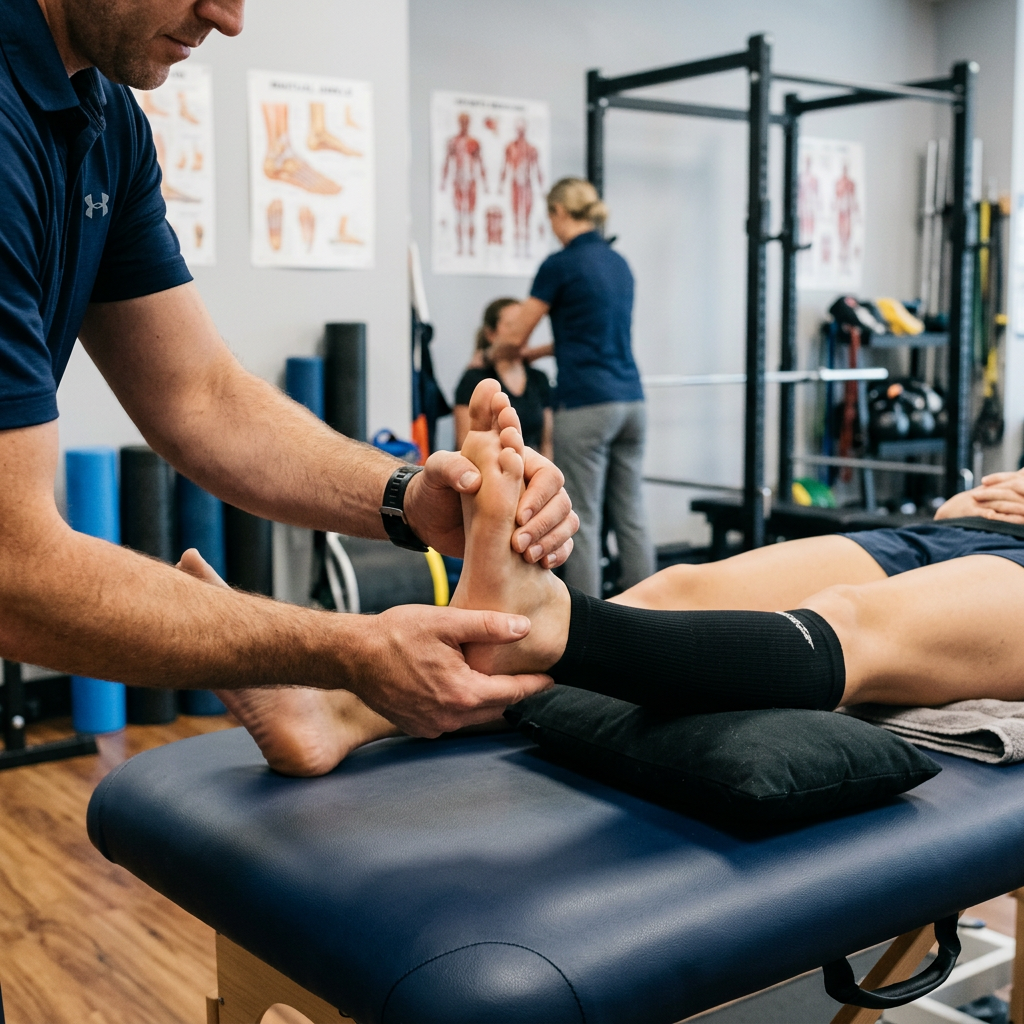
Your ankles are the quiet workhorse of your lower body. You probably don’t think about them much—until something goes wrong. But here’s what many people don’t realise: your ankle mobility has a profound impact on your entire body, from your knees and hips to your spine.
When your ankles lose mobility and flexibility, other joints—including your knees, hips, and spine—have to compensate. This compensation increases strain on these joints and can affect your posture, movement quality, and long-term joint health. Understanding the ankle-body connection and maintaining good ankle mobility is one of the most overlooked aspects of preventive health.
Please note: This article is for informational and educational purposes only. If you have ankle pain, a previous ankle injury, or are recovering from surgery, consult with a healthcare professional before starting new exercises.
The Hidden Importance of Ankle Mobility
When we think about what contributes to back pain, knee problems, or hip issues, we often overlook the feet and ankles. But the foundation matters enormously. Your ankles are literally the foundation upon which your entire kinetic chain is built.[1]
Your ankles perform critical functions:
Shock Absorption: Your ankles absorb forces from walking, running, and jumping, protecting your knees, hips, and spine from impact.
Balance and Stability: Proper ankle mobility allows for fine adjustments during movement, maintaining balance on uneven surfaces and preventing falls.
Movement Control: Mobile ankles enable fluid transitions through different positions—squatting, stepping, walking downhill—distributing forces efficiently through your body.
Proprioception: Your ankles provide crucial feedback to your nervous system about body position and movement, contributing to coordination and motor control.
Force Distribution: Mobile, strong ankles allow forces to be distributed throughout your entire kinetic chain rather than concentrated in one area.
The Compensation Cascade: How Limited Ankle Mobility Affects Your Whole Body
When your ankles don’t move properly, your body doesn’t simply stop moving—it finds alternative ways to accomplish the task. Unfortunately, these compensations often create problems elsewhere.
The Squat Example
Let’s look at a common example: the squat.
A proper squat requires adequate ankle mobility. Specifically, your ankle needs to dorsiflex (bend forward at the ankle) so your tibia (shin bone) can move forward over your foot while keeping your heel on the ground.
What happens when ankle mobility is limited:
If your ankles can’t bend properly, your body compensates by:
- Leaning your torso forward excessively to maintain balance
- Shifting weight onto your toes instead of keeping it in your heel
- Limiting how deep you can squat safely
- Placing extra stress on your hips, lower back, and knees to accomplish the movement
This forward lean and weight shift puts tremendous stress on structures that shouldn’t be bearing this load:
- Your lumbar spine experiences excessive compressive and shear forces
- Your hip flexors work overtime
- Your knees bear stress from improper alignment
- Your hamstrings and glutes can’t work optimally
Over time, this compensation pattern contributes to lower back pain, hip discomfort, knee problems, and poor movement quality.[2]
Stair Climbing and Downhill Walking
Stairs and downhill walking present similar challenges. These movements require excellent ankle control and mobility.
When ankles are restricted:
- You can’t control the lowering phase properly
- Your knees absorb excessive force
- Your hip stabilisers work overtime
- Your lower back compensates with excessive movement
- You may experience discomfort in any of these areas during or after these activities
The Whole-Body Benefits of Good Ankle Mobility
Mobile, strong ankles don’t just help the ankle itself—they support your entire lower body and spine.
Improved Balance and Coordination: Mobile ankles provide the fine control needed for balance, allowing for minute adjustments during standing and walking.[3]
Better Movement Quality: Good ankle mobility allows forces to distribute efficiently through your entire kinetic chain, creating smoother, more controlled movement.
Reduced Compensation Patterns: When your ankles can do their job, other joints don’t have to compensate, reducing strain throughout your body.
Improved Core Stability: Your ankle proprioceptors feed crucial information to your core muscles, helping them activate and stabilize your spine effectively.
Lower Injury Risk: Proper ankle mobility and strength reduce your risk of ankle sprains, knee injuries, hip pain, and back problems.[4]
Better Athletic Performance: Whether you play sports or simply want to stay active, ankle mobility contributes to performance and injury prevention.
Signs Your Ankles Need Attention
How do you know if your ankle mobility is limiting your movement and potentially affecting other areas of your body?
Watch for These Signs:
Recurring Ankle Injuries or “Giving Way” If you frequently roll or sprain your ankle on uneven ground, or your ankle feels like it’s going to give way, this indicates ankle instability and inadequate proprioception.
Difficulty Keeping Heels Down When Squatting If your heels come off the ground when you try to squat, or you find it very difficult to keep them down, this is a classic sign of limited ankle dorsiflexion (forward bending).
Back or Hip Discomfort During Lunges, Stairs, or Downhill Walking If you feel discomfort in your lower back or hips during these movements (but not in your ankle), your ankle mobility limitation may be the culprit, forcing other joints to compensate.
Morning Ankle Stiffness or Stiffness After Sitting If your ankles feel stiff and tight when you first get out of bed or after sitting for a while, your ankle mobility is likely limited.
Pain or Swelling After Activity Ankle pain or swelling that develops after activity (even if the activity didn’t involve your ankle) suggests your ankle isn’t handling its load efficiently.
Uneven Wear on Your Shoes Excessive wear on the inside or outside of your shoe soles can indicate abnormal foot and ankle mechanics.
Common Causes of Ankle Mobility Loss
Several factors contribute to limited ankle mobility:
Previous Ankle Sprains: Ankle sprains that weren’t fully rehabilitated often leave people with residual stiffness and weakness. The injury heals, but full mobility and proprioceptive training isn’t completed.
Tight Calf Muscles: Your calf muscles directly affect ankle mobility. Tight calves restrict dorsiflexion and contribute to ankle stiffness.
Sedentary Lifestyle: Hours of sitting keep your ankles in a plantar-flexed (pointed) position, restricting their range of motion.
Wearing Shoes with Reduced Heel Height: Barefoot and minimal shoe time is gradually being reduced in modern life. High heels (or even standard dress shoes) keep ankles in restricted positions.
Wear and Tear: Over time, particularly in people who’ve had previous injuries or weren’t doing preventive care, ankle joints develop degenerative changes.
Improper Footwear: Shoes that don’t provide adequate support or that restrict natural foot motion can contribute to ankle dysfunction.
Improving Ankle Mobility and Strength
The good news: ankle mobility can be improved with consistent, progressive exercises. Most people notice improvement within 3-4 weeks of regular practice.
Exercise 1: Calf and Ankle Stretches
This stretch specifically targets the gastrocnemius and soleus muscles (your calf muscles), which are often tight and restrict ankle mobility.
Setup: Sit comfortably with both legs extended in front of you.
The Exercise:
- Extend one leg with your heel on the ground
- Keep your knee straight and gently pull the top of your foot toward your shin (dorsiflex your ankle)
- Feel the stretch in your calf muscle
- Hold for 20 to 30 seconds. Don’t push to pain—gentle stretch only.
- Stop immediately if the stretch becomes painful
- Repeat 3 times on each side
- Do this stretch 1-2 times daily, or even multiple times throughout the day
Key Points:
- Gentle sustained stretch is more effective than bouncing
- Consistency matters more than intensity
- This is one of the most important ankle mobility exercises
- Improved calf flexibility directly improves ankle dorsiflexion
Exercise 2: Ankle Mobility Movements
This exercise explores your ankle’s full range of motion.
Setup: Sit comfortably or stand while holding onto something for balance.
The Movement:
- Move your ankle up (plantar flexion) – point your toes
- Move your ankle down (dorsi flexion) – bring toes toward your shin
- Move your ankle side to side – invert (turn sole inward) and evert (turn sole outward)
- Move in gentle circles – make slow, controlled circles with your ankle in both directions
- Do this for 1-2 minutes on each ankle, moving smoothly and exploring full range of motion
- Repeat daily, or even multiple times per day
Key Points:
- Move slowly and with control
- Explore your full comfortable range of motion
- Don’t force movement that causes pain
- This helps maintain and improve your ankle’s range of motion
Exercise 3: Single-Leg Balance
This exercise challenges your ankle’s proprioceptive ability (its sense of position) and improves balance and coordination.
Setup: Stand safely with something you can hold onto if needed.
The Exercise:
- Stand on one leg with your opposite knee straight or slightly bent to increase the challenge
- Hold for up to 30 seconds while breathing normally
- Use support (wall, counter, or holding hands) if needed – this is fine and still builds strength
- Focus on keeping your body stable without shifting too much
- Repeat 3-5 times on each leg
- Do this daily to improve balance and ankle proprioception
Progressions:
- Start with hand support, then try with just fingertip contact, then unsupported
- Close your eyes to make it more challenging
- Stand on uneven surfaces (carpet, pillow) to increase difficulty
- Do this on the injured ankle first if you have one
Key Points:
- Balance exercises improve proprioception and prevent future ankle injuries
- This is especially important if you’ve had previous ankle sprains
- Don’t rush the progression—master each level before advancing
Exercise 4: Whole-Body Movement
The most important thing is integrating ankle mobility into functional, whole-body movements.
Include these movements regularly:
Comfortable Squats: Perform squats focusing on keeping your heels on the ground and allowing your ankles to move forward over your feet.
Step-ups: Step up onto a low step or curb, focusing on controlled, balanced movement.
Walking: Regular walking, particularly on varied terrain (grass, trails), naturally improves ankle mobility and proprioception.
Gentle Downhill Walking: Walking downhill or down stairs slowly and with control challenges and improves ankle control.
Multi-directional Movement: Move forward, backward, and side to side, forcing your ankles to adapt to different movement demands.
Key Point: Functional movement is the ultimate goal. Your ankle needs to be mobile and strong enough to handle real-world activities.
Recovery After Ankle Injury
If you’ve had an ankle sprain or other ankle injury, full rehabilitation is crucial.
Important: If you’ve had an ankle injury or surgery, consult with a healthcare professional before starting new exercises. Recovery timelines and progressions vary depending on the severity of injury.
Common mistakes after ankle injury:
- Stopping rehabilitation too early (ankle feels better, but stability isn’t restored)
- Not addressing proprioceptive deficits
- Rushing back to activities before full strength and mobility return
- Not treating the underlying cause of the injury
Proper rehabilitation typically includes:
- Initial pain and swelling management
- Gradual restoration of range of motion
- Progressive strengthening
- Proprioceptive training (balance and coordination)
- Functional movement retraining
- Return to activity protocol
The Kinetic Chain Connection: Ankles and Your Spine
Here’s something important: your ankle mobility has a direct effect on your spine.
Your entire lower body—from your feet through your knees, hips, and into your spine—functions as an integrated kinetic chain.[5] When one part doesn’t move properly, everything else compensates.
Limited ankle mobility forces your knees to work harder, which affects your hips, which in turn affects your lower back and spine.
Conversely, improving ankle mobility:
- Takes pressure off your knees
- Improves hip mechanics
- Reduces stress on your lower back
- Allows your spine to move more naturally
- Improves overall posture and movement quality
This is why ankle mobility is so important for spinal health.
A Chiropractic Perspective
At Adam’s Back, we understand that the body functions as an integrated system. Back pain, knee pain, or hip pain often has its roots in problems elsewhere in the kinetic chain—sometimes as far away as the ankle.
Comprehensive Assessment
Chiropractic care may include:
Movement Analysis: Observing how you move (how you squat, walk, go up stairs) to identify where movement breaks down or compensations occur
Foot and Ankle Assessment: Evaluating foot posture, ankle range of motion, ankle strength, and proprioception
Balance Testing: Assessing your ability to maintain balance, which reveals ankle proprioceptive function
Hip and Spinal Assessment: Checking hip control and spinal alignment, which may be affected by ankle dysfunction
Functional Movement Screening: Evaluating how your entire kinetic chain works together during functional activities
Treatment Options
Based on assessment findings, care may include:
Ankle Adjustments: Restoring proper joint motion if ankle joints are restricted
Soft Tissue Work: Addressing tight calf muscles and other tissues affecting ankle mobility
Targeted Exercises: Specific exercises tailored to your ankle dysfunction and how it’s affecting your whole body
Movement Re-education: Teaching you how to move properly, using your ankles effectively
Posture and Gait Analysis: Identifying and correcting movement patterns that affect your entire kinetic chain
Timeline for Improvement
With consistent, daily practice:
1-2 weeks: You may notice your ankle feels slightly less stiff, particularly in the morning
2-4 weeks: Most people notice significant improvement in ankle mobility and reduced stiffness
4-8 weeks: Strength improvements become noticeable; movements that were previously uncomfortable become easier
8+ weeks: Full adaptation and new strength/mobility become stable, new movement patterns are established
The key is consistency. Daily practice produces better results than sporadic exercise.
Practical Tips for Daily Ankle Care
Make Ankle Mobility a Habit
Pair with existing habits:
- Stretch your calves while brushing your teeth (morning and night)
- Do ankle mobility movements while watching TV
- Practice single-leg balance while waiting for your coffee to brew
- Walk on varied terrain during your daily walks
Set reminders: Use phone reminders to do your ankle exercises at specific times (morning, midday, evening)
Support Ankle Health
Vary your footwear: Don’t wear the same shoes every day. Mix flats, supportive shoes, and minimal shoes to encourage natural foot and ankle movement.
Go barefoot: When it’s safe and appropriate, barefoot time strengthens your feet and ankles naturally.
Maintain general fitness: Regular exercise and activity naturally supports ankle health.
Stay hydrated: Proper hydration supports tissue health and recovery.
Manage inflammation: If you have chronic ankle swelling or pain, address it with your healthcare provider.
The Bottom Line
Your ankles might be quiet, but they’re absolutely essential to your whole-body health and function. Limited ankle mobility doesn’t just affect your ankle—it creates a cascade of compensations affecting your knees, hips, spine, and overall movement quality.
The good news is that ankle mobility improves with consistent, progressive exercise. Most people notice significant improvement within 3-4 weeks of daily practice.
Investing in your ankle health now pays dividends in: ✓ Improved movement quality ✓ Reduced pain and discomfort ✓ Better balance and coordination ✓ Lower injury risk ✓ Better spinal health ✓ Improved athletic performance ✓ Better quality of life
Start from the ground up. Take care of your ankles, and the rest of your body will thank you.
Visit Adam’s Back
Located at 881 Point Nepean Road in Rosebud, Adam’s Back provides comprehensive assessment and guidance for ankle mobility and whole-body movement quality.
If you’re experiencing ankle pain, have had previous ankle injuries, or notice that other areas of your body are compensating for ankle limitations, professional assessment can identify the root cause and create a personalised treatment plan.
Whether you’re recovering from ankle injury or want to prevent future problems, we can help optimize your ankle function and support your whole-body health.
Ready to improve your ankle mobility from the ground up? Contact us today.
📍 881 Point Nepean Road, Rosebud 📞 03 5986 5700 🌐 adamsback.com.au
References
[1] Gribble PA, Hertel J. Considerations for normalizing measures of the Star Excursion Balance Test. Meas Phys Educ Exerc Sci. 2003;7(3):159-177.
[2] Van Dillen LR, Bloom NJ, Gombatto SP, Susco TM. Hip rotation range of motion in people with and without low back pain who participate in rotation-related sports. Phys Ther Sport. 2008;9(2):72-81.
[3] Haddad JM, Swanik CB, Lirgg CD, Swanik KA. Relationship between the modified Star Excursion Balance Test and Y Balance Test. J Sports Rehabil. 2013;22(2):88-93.
[4] McKeon PO, Hertel J. Systematic review of postural control and lateral ankle instability, part I: can deficits be detected with instrumented testing. J Athl Train. 2010;45(6):630-640.
[5] Kibler WB, Press J, Sciascia A. The role of core stability in athletic function. Sports Med. 2006;36(3):189-198.
Disclaimer: This blog post is for informational and educational purposes only. It is not intended as medical advice and should not be used to diagnose or treat any health condition. The information presented does not replace professional chiropractic evaluation and treatment. Always consult with a qualified healthcare professional regarding ankle pain, previous ankle injury, or other health concerns.

Comments are closed